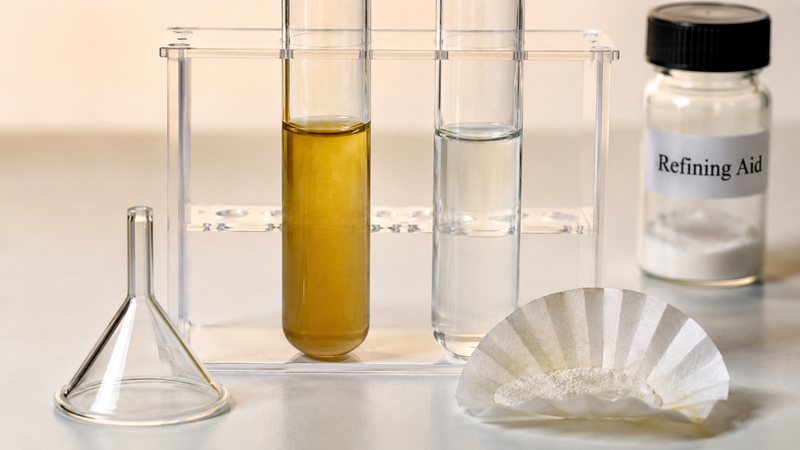
Silica hydrogel adsorbs phospholipids and residual soaps ahead of the bleaching stage, so bleaching earth is left to remove pigment rather than gums. Refiners running a silica pre-bleach step commonly report bleaching-earth reductions of around a third alongside residual phosphorus consistently below 5 ppm.
Why bleaching earth is an expensive way to remove phospholipids
Bleaching earth is engineered to adsorb pigments, oxidation products and trace metals, and it will also adsorb phospholipids — but at a poor exchange rate. Phospholipids are large, polar and strongly surface-active, so they occupy a disproportionate share of the earth's adsorption capacity relative to their mass. When water degumming leaves residual phosphorus in the 15-25 ppm range, a significant fraction of the bleaching earth dose is consumed by gums before it does any pigment work.
Two costs follow. The obvious one is earth consumption, which rises to compensate. The less obvious one is neutral-oil loss: bleaching earth retains oil in its pore structure, so every additional tonne of earth carries additional oil to the filter cake and out of the process. Refiners comparing adsorbent options on price per tonne alone routinely miss this second cost, which in high-gum feedstocks can exceed the earth cost itself.
Why a high-surface-area silica changes the economics
Silica hydrogel is selective for the polar species that bleaching earth handles inefficiently. A grade at BET 400-600 m²/g (ISO 9277) presents a large, accessible pore network that preferentially adsorbs phospholipids, residual soaps and trace metals from the oil ahead of the bleaching stage. Because the adsorption is selective, a small silica dose removes the species that would otherwise have consumed a much larger mass of earth.
The pH of the adsorbent matters here. A grade at pH 4.0-6.5 (ISO 6588) is mildly acidic in aqueous suspension, which supports the adsorption of residual soaps left by neutralisation. The higher bulk density typical of these grades, at 350-500 g/L (ISO 60), also means the silica handles and doses like a conventional adsorbent in existing equipment rather than requiring new handling systems.
The result is a shift in what each material is asked to do: silica handles gums and soaps, earth handles colour. Total adsorbent cost and neutral-oil loss both fall, even though a second material has been added to the process.
VS-OE550 Adsorbent — parameters relevant to edible-oil refining
| Property | Unit | VS-OE550 Adsorbent | Test method | Why it matters in refining |
|---|---|---|---|---|
| BET specific surface area | m²/g | 400 – 600 | ISO 9277 / DIN 66131 | Accessible surface for phospholipid and soap adsorption |
| pH (5% aq. suspension) | — | 4.0 – 6.5 | ISO 6588 | Mildly acidic; supports adsorption of residual soaps |
| Bulk density (poured) | g/L | 350 – 500 | ISO 60 | Handles and doses like a conventional adsorbent in existing equipment |
| Particle size D50 | µm | 8 – 18 | ISO 13320 | Balances adsorption kinetics against filtration behaviour |
| Oil absorption (DOP) | g/100g | 180 – 260 | ISO 4652 / DIN 53617 | Indicates oil retained in the filter cake |
| Loss on drying (105 °C, 2 h) | % | ≤ 8.0 | ISO 787-2 | Bound water available for the adsorption mechanism |
| SiO₂ content (dry basis) | % | ≥ 98.0 | Gravimetric / XRF | Purity relevant to food-contact processing |
Selection framework
Measure residual phosphorus after degumming, not after bleaching
Establish the actual gum load entering the bleaching stage. Refiners who only measure the finished oil cannot tell how much of their earth dose is being spent on phospholipids, which is the number that determines whether a pre-bleach silica step pays.
Dose silica into pre-bleaching, ahead of the earth addition
The selectivity advantage only exists if the silica meets the gums before the earth does. Adding silica simultaneously with bleaching earth forfeits most of the benefit, because both materials then compete for the same species.
Calculate on total adsorbent cost plus neutral-oil loss
Compare the silica-plus-earth route against the earth-only route on the sum of both adsorbent costs and the oil retained in filter cake. Comparing price per tonne of adsorbent in isolation is the most common reason a viable project is rejected.
Check filtration behaviour before scaling
Silica changes filter-cake structure and often extends cycle time, but the effect depends on the existing filter configuration. Confirm cycle length and cake permeability at plant scale rather than assuming the laboratory result transfers.
Set the dose from the gum load, then step down
Begin at a dose sized to the measured phosphorus load and reduce across production runs while tracking residual phosphorus. Doses reported in refinery practice are typically a fraction of the bleaching-earth dose they displace.
Field case — Spain
System: Crude pomace oil refining, 200 t/day · Grade: VS-OE550
Problem. Water degumming left residual phospholipids at 18-22 ppm, forcing over-bleaching that raised bleaching-earth consumption and neutral-oil loss.
Action. Silica hydrogel at BET 400-600 m²/g was dosed at 0.12% w/w into pre-bleaching, adsorbing phospholipids and trace soaps ahead of the bleaching-earth stage.
Result.
- Residual phosphorus held consistently below 5 ppm
- Bleaching-earth consumption down 35%
- Filter cycle extended from 4 h to 7 h
- Approximately EUR 48,000 in annual savings
Frequently asked questions
Does silica replace bleaching earth in edible-oil refining?
Silica does not replace bleaching earth; it changes what each material is asked to do. Silica adsorbs phospholipids, residual soaps and trace metals in a pre-bleach step, leaving bleaching earth to remove pigment and oxidation products. Total adsorbent consumption normally falls even though two materials are in use.
Where in the refining process should silica adsorbent be dosed?
Silica should be dosed into pre-bleaching, ahead of the bleaching-earth addition. The selectivity benefit depends on the silica contacting the gums first. Dosing both materials at the same point causes them to compete for the same species and forfeits most of the advantage.
How is the payback on a silica pre-bleach step calculated?
Payback is the sum of reduced bleaching-earth cost and reduced neutral-oil loss in filter cake, set against the silica cost. Neutral-oil loss is the term most often omitted, and in high-gum feedstocks it can be larger than the earth saving itself. Filter-cycle extension is a further contribution where throughput is filtration-limited.
Related: Oil refining solution overview · Full grade specifications · All articles