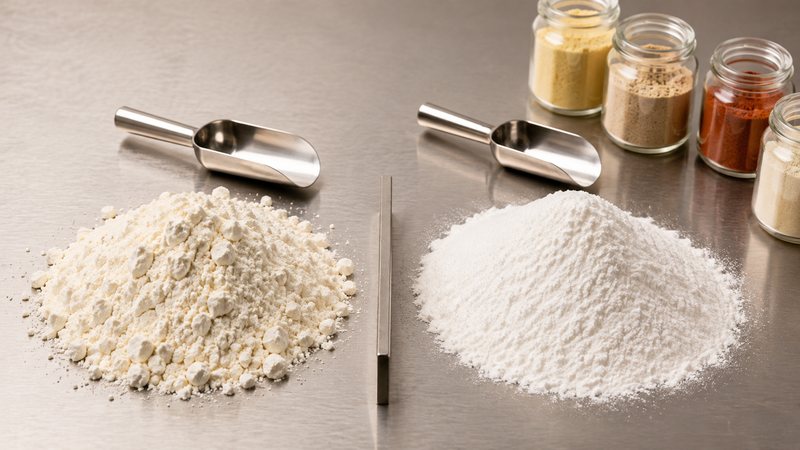
Anti-caking performance depends on surface coverage of the host powder, not on dosage alone. A flow aid at D50 5-12 µm (ISO 13320) covers far more host surface per unit mass than a coarse grade, so blends with fine, hygroscopic or high-fat hosts need a finer silica rather than more of a coarse one.
Why caking is a bridging problem, not a moisture problem
Caking in food powders is caused by bridges forming between host particles, and moisture is only one route to those bridges. Liquid bridging occurs when ambient humidity condenses at contact points and dissolves soluble components such as salt, sugar or organic acids, which then recrystallise into solid necks. Fat bridging occurs in blends containing oleoresins, dairy solids or roasted spice, where fat softens above its melting range and re-solidifies across contacts. Mechanical interlocking occurs in irregular, plate-like particles independently of both.
Silica interrupts all three by occupying the contact points. Fine silica particles adsorb onto the host surface and act as physical spacers, so the host particles never touch closely enough to form a neck. This is a surface-coverage mechanism, which is why the effective variable is how much host surface a given mass of silica can cover — and that is governed by particle size and density, not by the percentage on the batch sheet.
Why the same dosage gives different results across blends
Two blends at the same silica dosage can behave completely differently because their host surface areas differ by an order of magnitude. A coarse granulated seasoning at 300 µm has a fraction of the specific surface of a milled spice powder at 40 µm. The same 0.5% silica loading therefore delivers thick coverage in one and sparse, patchy coverage in the other.
Fat content shifts the requirement again. Blends carrying oleoresin, cheese powder or roasted nut solids need silica that can adsorb free surface fat as well as separate particles, which raises the useful oil absorption range. Hygroscopic blends dominated by salt or acidulants need coverage to be continuous, because a single uncovered contact point is enough to nucleate a bridge.
The practical consequence is that dosage transfers poorly between SKUs. A validated loading on one export blend is a starting hypothesis for the next one, not a specification.
VS-F120 Flow Aid — parameters relevant to food powder anti-caking
| Property | Unit | VS-F120 Flow Aid | Test method | Why it matters for dry blends |
|---|---|---|---|---|
| Particle size D50 | µm | 5 – 12 | ISO 13320 | Determines host surface covered per unit mass of silica |
| BET specific surface area | m²/g | 100 – 150 | ISO 9277 / DIN 66131 | Adsorption capacity for surface moisture and free fat |
| Oil absorption (DOP) | g/100g | 180 – 230 | ISO 4652 / DIN 53617 | Capacity to bind free fat in oleoresin-bearing blends |
| Tapped density | g/L | 170 – 250 | ISO 697 | Resistance to consolidation in sachets and bulk bags |
| Sieve residue (45 µm) | % | ≤ 0.05 | ISO 2591-1 | Coarse fraction that would be visible or gritty in the blend |
| Loss on drying (105 °C, 2 h) | % | 4.0 – 6.0 | ISO 787-2 | Moisture the flow aid contributes to a hygroscopic system |
| pH (5% aq. suspension) | — | 6.0 – 7.5 | ISO 6588 | Near-neutral; avoids interaction with acidulants and colours |
Selection framework
Identify which bridging mechanism dominates
Test the blend at elevated humidity and at elevated temperature separately. If it blocks under humidity but not heat, the mechanism is liquid bridging and coverage continuity matters most. If it blocks under heat, fat bridging dominates and oil absorption capacity becomes the controlling parameter.
Estimate host surface area before setting a dosage
Take the host D50 and bulk density and compare against a blend where the dosage is already validated. A host that is twice as fine needs roughly twice the coverage to reach the same protection, which usually means a finer silica rather than a proportionally larger dosage.
Match particle size to the finest host component
A flow aid at D50 5-12 µm (ISO 13320) with 45 µm sieve residue at or below 0.05% (ISO 2591-1) coats fine milled spice without introducing perceptible grit. Coarser grades leave uncovered surface on the fine fraction, which is where bridging nucleates.
Run humidity-chamber validation against an untreated control
Hold treated and untreated samples at conditions representative of the destination market for at least four weeks. Assess by flow function and visual blocking. A treated sample that free-flows while the control blocks is the evidence a distributor will accept.
Verify sensory neutrality before scaling
Precipitated silica is used at low loadings and is sensorially inert in most systems, but confirm with a triangle test on the finished blend before rolling out across SKUs, particularly for delicate aroma profiles.
Field case — Indonesia
System: Spice-blend sachets for humid export markets · Grade: VS-FC200
Problem. Caking in spice-blend sachets shipped to Malaysia and the UAE drove distributor returns to roughly 3.2% of export volume.
Action. A food-grade anti-caking silica was added at 0.6% to the top three export SKUs and validated with 40 °C / 75% RH humidity-chamber testing on treated versus untreated samples.
Result.
- After four weeks at 40 °C / 75% RH the treated samples remained free-flowing while the untreated control blocked
- Caking-related returns fell from 3.2% to under 0.3%
- No detectable taste or aroma impact (triangle test, n = 60)
- Extended to seven further export SKUs within 12 months
Frequently asked questions
What dosage of anti-caking silica is needed in a seasoning blend?
Dosage follows host surface area rather than a fixed rule. Coarse granulated blends need less coverage than finely milled spice powders at the same protection level. Validated loadings in published food applications commonly fall below 2%, and regulatory limits for silicon dioxide as an anti-caking agent apply in each destination market. Confirm the working level on the actual blend with a humidity-chamber trial.
Does anti-caking silica affect the taste or aroma of a seasoning?
Precipitated silica is chemically inert and is used at low loadings, so it is normally sensorially neutral. Delicate aroma profiles should still be confirmed with a triangle test on the finished blend, because adsorption of volatile aroma compounds onto a high-surface-area powder is possible in principle at higher loadings.
Why does a blend cake in export markets but not in the domestic warehouse?
Destination humidity and container temperature cycling drive moisture condensation and recrystallisation that a temperate warehouse never produces. Validation should be run at conditions representative of the destination — commonly 40 °C and 75% RH for tropical export — rather than at ambient production-site conditions.
Related: Food powders solution overview · Full grade specifications · All articles