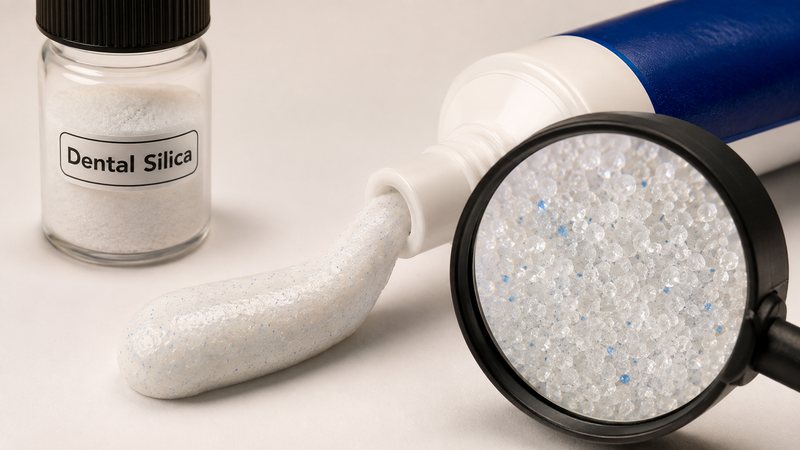
Dentifrice silica works on two independent routes. Abrasive grades at BET 45-90 m²/g (ISO 9277) control cleaning and RDA, while thickener grades at BET 350-450 m²/g build structure and suspend actives. Changing one route shifts the other, so both should be varied in parallel rather than sequentially.
Why abrasive and thickener silica behave as two different materials
Abrasive and thickener grades are both precipitated silica, yet they are engineered toward opposite ends of the structure spectrum. Abrasive grades are relatively dense and low in surface area, at BET 45-90 m²/g with tapped density 280-400 g/L, so individual particles retain enough hardness and mass to remove pellicle and stain from enamel. Thickener grades are highly structured and open, at BET 350-450 m²/g with tapped density 110-170 g/L, so they build a three-dimensional network in the aqueous phase that raises yield stress.
The two roles are physically separable, and that separation is what makes dentifrice formulation tractable. Cleaning performance is dominated by the abrasive fraction's particle size and hardness; rheology is dominated by the thickener fraction's structure and concentration. A formulator can move cleaning without redesigning the gel network, provided both grades are specified independently.
Why the two routes still interact in the finished paste
The independence is partial, and the coupling is what makes single-variable development slow. Abrasive particles occupy volume in the continuous phase, so raising the abrasive load raises apparent viscosity even with the thickener held constant. Thickener silica adsorbs water into its pore structure, reducing free water and changing how the abrasive fraction packs and settles. Both grades contribute surface area that competes for humectant and for active ingredients such as fluoride salts.
Paste stability sits at the intersection. A paste with adequate viscosity but insufficient yield stress will show abrasive sedimentation over shelf life; a paste with excessive structure will be difficult to extrude and may exhibit syneresis after temperature cycling. Because a change on either route moves both viscosity and stability, a formulator who varies abrasive first and thickener afterwards typically needs two full development cycles to converge. Varying both in a small factorial from the start converges in one.
Dentifrice silica routes — abrasive versus thickener parameters
| Property | Unit | VS-A070 Abrasive | VS-T400 Thickener | Test method |
|---|---|---|---|---|
| BET specific surface area | m²/g | 45 – 90 | 350 – 450 | ISO 9277 / DIN 66131 |
| Oil absorption (DOP) | g/100g | 90 – 140 | 260 – 310 | ISO 4652 / DIN 53617 |
| Particle size D50 | µm | 6 – 12 | 8 – 15 | ISO 13320 |
| Tapped density | g/L | 280 – 400 | 110 – 170 | ISO 697 |
| Bulk density (poured) | g/L | 180 – 260 | 70 – 110 | ISO 60 |
| pH (5% aq. suspension) | — | 6.5 – 7.5 | 6.5 – 7.5 | ISO 6588 |
| Sieve residue (45 µm) | % | ≤ 0.05 | ≤ 0.10 | ISO 2591-1 |
| SiO₂ content (dry basis) | % | ≥ 98.0 | ≥ 97.0 | Gravimetric / XRF |
Selection framework
Fix the cleaning target before touching rheology
Define the intended RDA band and cleaning claim first, because that decision constrains the abrasive fraction and therefore the volume the thickener has to work around. RDA is measured on the finished paste under ISO 11609, not predicted from raw-material parameters alone.
Select the abrasive route on particle size and hardness, not on surface area
Cleaning is driven by particle size distribution and the absence of oversize. An abrasive grade at D50 6-12 µm with 45 µm sieve residue at or below 0.05% (ISO 2591-1) gives cleaning action without the oversize particles that drive RDA outliers and consumer grittiness complaints.
Select the thickener route on structure, not on dosage
Yield stress comes from the network a structured grade builds, so a grade at BET 350-450 m²/g and tapped density 110-170 g/L reaches target rheology at a lower loading than a denser alternative. Raising the loading of a low-structure grade to compensate consumes water and destabilises the paste.
Run both routes as a small factorial in the first round
Test at least two abrasive levels against two thickener levels in the same round. Because the routes are coupled through free water and packing, a sequential approach usually needs a second development cycle to reach the same point.
Validate on stability, not only on initial viscosity
Assess extrusion force, yield stress and sedimentation after temperature cycling rather than on freshly made paste. Sedimentation and syneresis appear during ageing, and initial viscosity does not predict either.
Frequently asked questions
What is the difference between abrasive silica and thickener silica in toothpaste?
Abrasive silica is denser and lower in surface area, typically BET 45-90 m²/g with tapped density 280-400 g/L, and provides cleaning and stain removal. Thickener silica is highly structured, typically BET 350-450 m²/g with tapped density 110-170 g/L, and builds the yield stress that holds the paste together and suspends actives. Most dentifrice formulations use both.
Can a single silica grade serve as both abrasive and thickener?
Some intermediate grades provide partial function on both routes, and they are used where formulation simplicity outweighs performance optimisation. The trade-off is that neither cleaning nor rheology can be adjusted independently afterwards, so reformulation for a new claim generally requires returning to a two-grade system.
Why does toothpaste viscosity change when only the abrasive level is adjusted?
Abrasive particles occupy volume in the continuous phase and compete for free water, so raising the abrasive load raises apparent viscosity even at constant thickener level. This coupling is why abrasive and thickener levels are more reliably varied together in a factorial rather than one at a time.
Related: Oral care solution overview · Full grade specifications · All articles